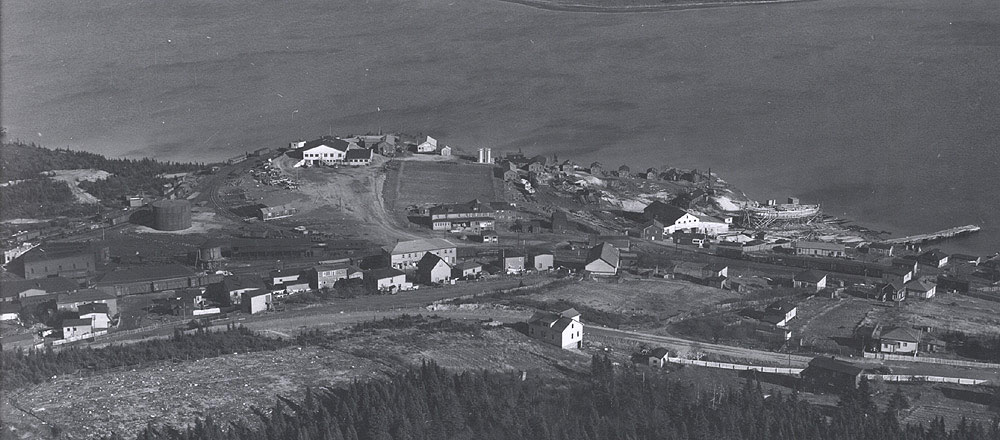
When Clarenville Became a Town
The Town of Clarenville
Originally settled by loggers, farmers and trappers, Clarenville was established in 1891 by the amalgamation of the settlements of Lower Shoal Harbour, Dark Hole, Brook Cove, Broad Cove and Red Beach. It was originally known as “Clarenceville” which later changed to the current name.
The year 1951 stands as a watershed moment for Clarenville, marking its transition from a collection of loosely associated settlements into a unified, self-governing municipality.
While the area had been a vital “hub” for the railway and logging industries since the late 1800s, it wasn’t until after Newfoundland joined Confederation in 1949 that the community sought the formal structure of a Town Council.
There was a growing provincial push for local regions to take charge of their own services — such as water, waste management, and fire protection. Clarenville, which by then had become an industrial mainstay due to the Clarenville Shipyard and the Newfoundland Hardwoods plant, was a natural candidate for local government.
On June 12, 1951, the Town of Clarenville was officially incorporated and July 10 marked the official beginning of municipal governance. We now mark the Town’s anniversary as July 10.
On July 10, 1951, Clarenville’s first Town Council was formed. It included Mayor Ernest Drover, Deputy Mayor Martin Bourne, and Councillors G.A. Myers, Malcolm Tulk, George Vardy, Edgar Stanley, and Boyce Smith.
Separately, Shoal Harbour was incorporated as its own municipality in February 1973. Its first Town Council consisted of Mayor Eric Butler, Deputy Mayor Harris Thistle, and Councillors Eli Dalton, William Sheppard, Rex Clarke, Bruce Coish, and Merlin Mills.
Eventually, Clarenville and Shoal Harbour merged to form a single municipality in 1994.
Shoal Harbour and Clarenville
Shoal Harbour, just to the north of Clarenville, maintained its own distinct identity for several more decades after Clarenville was incorporated. It has a history that is actually slightly older than Clarenville’s and is deeply tied to the land and water that defined the region.
Shoal Harbour’s history began with Scholar John Tilley. In 1848, he moved his family from Hants Harbour to Lower Shoal Harbour specifically for the “abundance of timber.”
Shoal Harbour became a bustling centre for logging and sawmilling. However, devastating forest fires in 1892 and 1903 ravaged the surrounding timberlands, starving the mills of their raw material.
Clarenville began to pull ahead of Shoal Harbour in the 1930s. Fueled by the war effort, Clarenville saw the establishment of an asphalt plant and a government shipyard for building wooden minesweepers.
Clarenville’s growth as a regional center led to a gradual shift in economic dominance, with Shoal Harbour becoming increasingly dependent on its younger, rapidly developing neighbour.
The two towns collaborated on services, with their water systems becoming interconnected and Shoal Harbour utilizing Clarenville’s garbage disposal facilities.
Shoal Harbour remained a separate community until February 15, 1994, when it and Clarenville amalgamated to become the Town of Clarenville. Even after the merger, Shoal Harbour fought to keep its own post office and address identity and residents remain proud of their community.
Today, Clarenville stands as the largest town in its region and the second fastest-growing town in Newfoundland and Labrador.
Sources: