Mrs. Cholock Packet Article
Written by Barbara Dean Simmons, The Packet
Through the years, The Packet had many conversations with Mrs. Cholock and in 2001 worked with her on a special project for Clarenville’s 50th anniversary. She also contributed as a freelance writer and photographer on several occasions through the years.
To honour a lady who was an inspiration to many through her business and life pursuits, The Packet felt it fitting to pay tribute by reprinting excerpts from a 2001 story about one of her lifelong passions — photography.
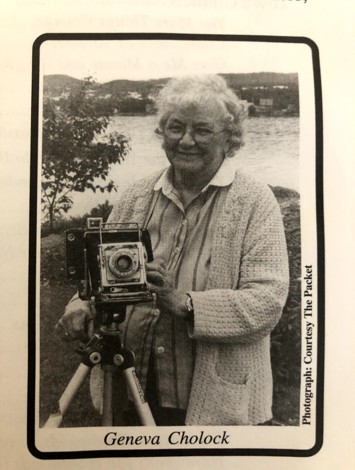
Geneva (Stanley) Cholock got her first camera in 1929.
She was just 11 years old and a relative was selling a Brownie model – a simple square box with a lens and a peephole. Geneva asked her mother, Blanche, if she could have it and fortunately, her mother said yes.
“She paid $2 for it,” recalls Geneva.
It was the beginning of a lifelong passion .
With no one to teach her the basic rules of photography, Geneva had to rely on her own artistic instinct when she first began recording images on film. Her only specific instruction was the one she got from her mother, who admonished her to make sure that the photos she took had a person in it. In those days, photographic film and the cost of developing was a bit of a luxury, reserved mainly for special occasions.
“You didn’t take a photo of anything unless there was a person standing in the picture somewhere. Scenery pictures were considered a ‘waste’,” Mrs. Cholock said with a laugh.
That simple Brownie was the first in a long line of cameras Geneva eventually bought, graduating to more modern models, and eventually 35 mm photography, as the years passed. Photography has always been a backdrop in her life. Soon after she married in 1945, she turned her photography skills into a job opportunity, with her cameras and a darkroom kit that her husband, Peter, gave her one Christmas.
“One Christmas I was walking down Water Street, in St. John’s, and in one of the stores I saw
this little darkroom kit there. And I said to Pete that I wanted it for Christmas.”
She got her wish. After intensely studying the instruction booklet that came with the kit, she developed her first roll of film. Soon, she was developing film for other people and making prints for herself.
Her first darkroom was no room of comfort, she recalled. It was a simple setup in a converted spare room on the second floor of their house on Marine Drive. To rinse the film and prints she had to use the sink in the bathroom across the hall.
A stovepipe from the downstairs kitchen ran straight up through the little room. Since the downstairs was also a restaurant — she and her husband operated the Royal Grill at the time — and the stove was pretty much always in use, it got pretty hot in that little room, especially in the summer.
The upstairs bathroom was also used by restaurant patrons. So it meant sometimes having to wait her turn to use the facilities to rinse the film.
Later, Geneva set up a small hairdressing business alongside the restaurant. She immediately installed a darkroom in the basement, providing her with a much more comfortable working environment.
Geneva quickly formed a habit of taking a camera with her wherever she went and she soon found another opportunity for her photographic skills.
She became a regular freelance writer and photographer for the Evening Telegram, and on one occasion had her photographs published in the Atlantic Guardian.
Telegram publisher Steve Herder became a good friend, she says.
Some of the more memorable events are the stories and photos of the tragedy in Port Blandford in the early 1960s when a car filled with people was thrown into the river when a bridge collapsed on the Bunyan’s Cove Road. She was at the scene for two or three days in a row, getting photos of the accident scene and the search for the victims.
She was also on the scene in the early 1960s when a boat loaded with asphalt went aground off Foster’s Point, Random Island.
And when forest fires broke out in 1961 in the woods behind Clarenville, Geneva and her husband Peter recorded some of the drama with her camera equipment.
She recalls that the fire came so close to Clarenville her husband feared they would have to evacuate their home on Marine Drive. However, Geneva had other things on her mind. She was buy developing film of the fire scenes from Swift Current, photographs her husband had taken a few days earlier.
When the fire moved closer to Clarenville, Mr. Cholock had to put down the camera and take up
fire fighting gear, as local men volunteered to fight back the flames. She remembers that a train stood waiting at the station in Clarenville, ready to take the townspeople out of danger if the fire got too close.
While many of her friends and neighbours were wondering what personal belongings they would
ake with them if they had to leave, Geneva was wondering if she would get all her film developed and prints made.
“I was in the darkroom, trying to get film developed. Every so often Pete would come in and knock on the (darkroom) door and say, ‘We’re going to have to go soon.’ Geneva would reply, ‘Yeah, just let me get this film finished.’
Fortunately, the townspeople of Clarenville never had to evacuate, the flames were extinguished and the Cholock’s photos of the forest fire were printed in The Telegram.
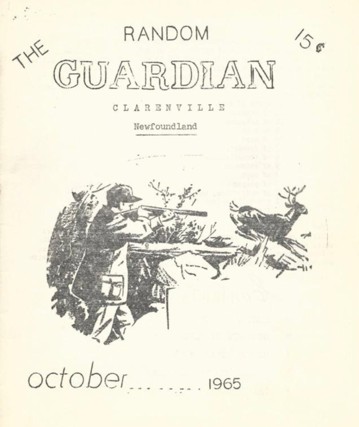
In 1962, after establishing herself as a freelance photographer and writer, Geneva decided to start her own newspaper in Clarenville. She consulted Ron Pumphrey, a well-known writer and broadcaster at that time, who provided advice.
Every month, for the next three years, she wrote and produced the Random Guardian, a small paper printed on a legal sized paper using a mimeograph machine that had to be cranked by hand.
Three years after she started the paper, she sold the enterprise to devote more time to other
pursuits. In the years since after that she took up other artistic pursuits, specifically oil painting. Yet her camera was never far from her side.
Thanks to her interest in and devotion to photography, Clarenville’s early progress as a developing town is forever stamped on film. Her photography has recorded the town’s progression from its days as a shipbuilding, railway town of dirt-roads and wood frame businesses, to the beginning of its coming-of-age as an important and expanding regional centre.
She says it never entered her mind when she was photographing those early street scenes that
someday the photos would have historic value.
Over the years, though, she loaned her photos to others — including The Packet, The Town of Clarenville and the Clarenville Historic Society — to help tell the story of the town’s history. And thanks to her stellar memory of past events, and her life experiences, she was always a source of information for those looking for information or inspiration.